Sussex
The teeth that started it
A glint beside a road in Sussex became a name, an early giant, and one of the first three dinosaurs. The museum keeps a hedge in the discovery story, and more than one official length in the modern one.
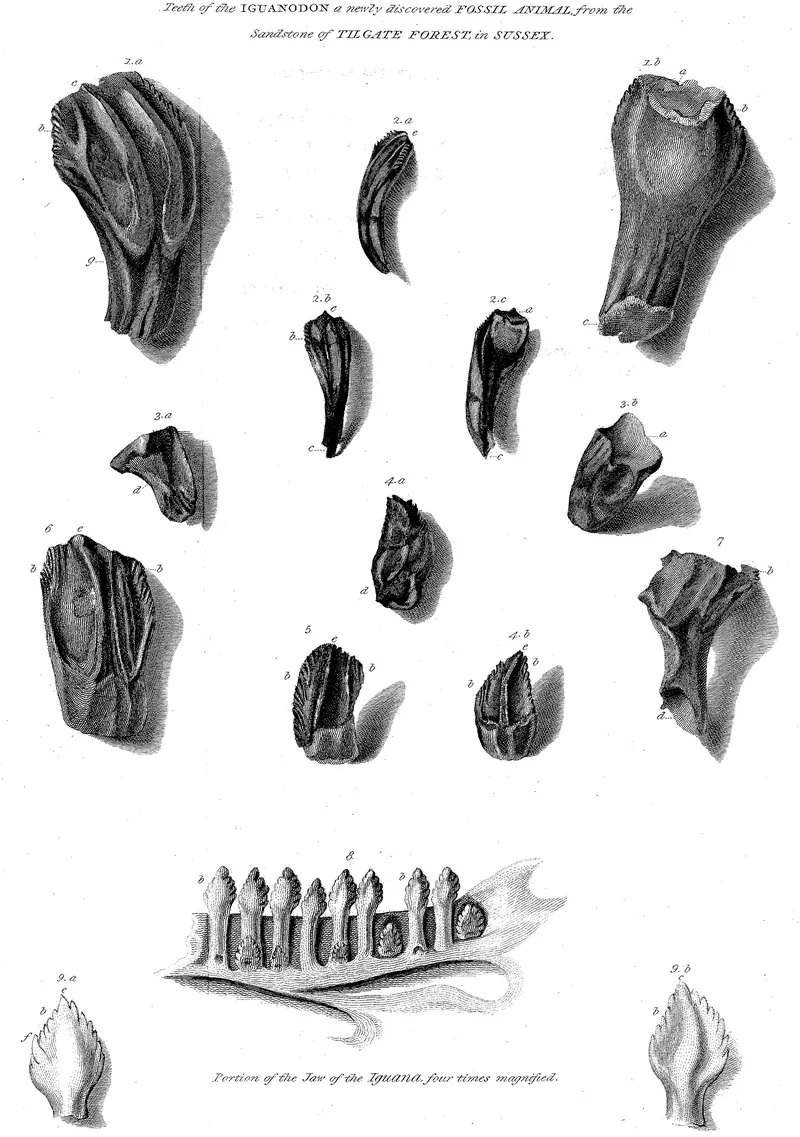
The plate is Gideon Mantell’s own illustration of the original teeth, from 1825. The discovery page places the find a little earlier: “Discovered in Sussex in 1822, a collection of teeth was the first evidence of a gigantic herbivorous reptile named Iguanodon.” [source] The later search article gives the publication year in one clean line: “In 1825, Dr Gideon Algernon Mantell – an English surgeon, geologist and palaeontologist – described several prehistoric teeth from the Wealden district of East Sussex. They looked like those of an iguana but considerably larger, so Gideon named his newfound discovery Iguanodon.” [source] The name, both pages agree, means iguana tooth.
Who saw them first is told with care. “Mary Ann Mantell (1795-1869) and her husband Dr Gideon Algernon Mantell (1790-1852), are recorded as having found the first evidence of Iguanodon.” Then the hedge that this desk is not willing to sand off: “Most accounts hold that Mary was accompanying her husband on a trip to visit a patient in Sussex, when she noticed something glinting by the side of the road. When Mary went to investigate she discovered a collection of fairly large teeth embedded in the rocks.” [source] Most accounts hold. Not a courtroom fact. A road, a patient, a glint, and a museum that still says “most accounts.”
The comparison that gave the animal its name also gave it an early, oversized body. “The fossilised teeth resembled those of the iguana, only many times larger.” Iguanas are “relatively large lizards,” but “scaled up the prehistoric owner of the fossilised teeth could have been up to 18 metres or longer.” The next sentence brings the animal back to a length the museum now stands behind: “We now know this dinosaur reached a length of about 10 metres.” [source] “About 10 metres” is not treated here as a correction of the directory’s 10.0 m, or of the Belgian masterpiece range of 9 to 11 metres. They are three official ways of writing a large herbivore, and they stay in their own sentences on the field notes.
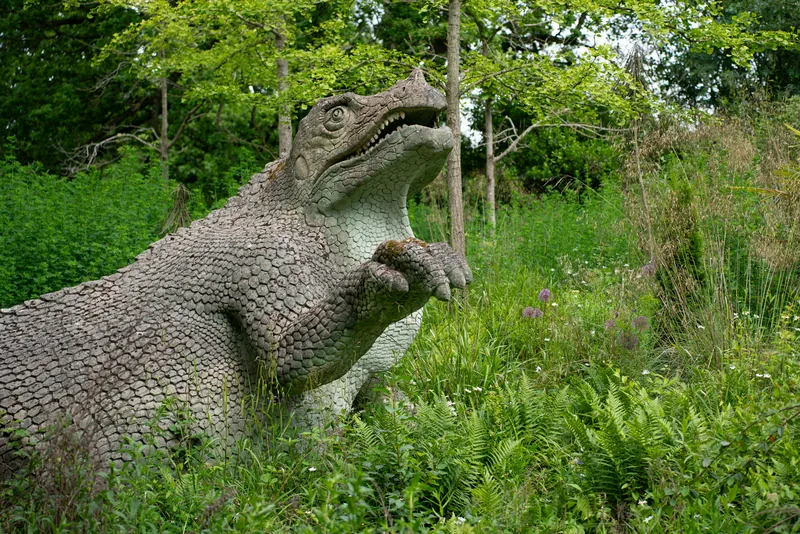
The teeth also pointed, for a while, at a face that was not quite right. Because the living rhinoceros iguana has a small horn near its snout, Mantell “determined that Iguanodon had a horn.” [source] That idea would still be prevailing when the Crystal Palace sculptures were planned. The teeth themselves, on the directory, are “chewing cheek teeth and horny beak,” and the food is plant material. [source] A herbivore, then, from the beginning: “a gigantic herbivorous reptile,” and, on the Belgian masterpiece page, “a large herbivorous dinosaur.” [source] [source]
The search article widens the frame. “Iguanodon was one of the first three dinosaurs to be discovered, but the renowned reptile may have swept up several misidentified skeletons along in its wake.” [source] One of those later names is Mantellisaurus atherfieldensis, which “has spent 80 years known as Iguanodon atherfieldensis.” The animal in Mantell’s 1825 description remains Iguanodon. The later splitting of English material is a different story, and it is told with the same caution on the Maidstone page. A typographic sheet keeps the teeth, the name, and the unblended lengths: The teeth that started it (A4) · Letter.
Enjoyed this desk on a horn that became a thumb, and a mine full of Iguanodons?
No pop-ups. No intrusive advertising. Just interesting stuff. A little support helps the next dinosaurs.im site get built.