The signature desk
On the nose, or on the thumb?
For decades the spike sat on the face. Then a later discovery moved it to the hand. The official wording still leaves a little room about what it was for.
The signature desk
On the nose, or on the thumb?
A spike that began life as a horn, and then moved. Official wording from the Natural History Museum, with the Belgian institute beside it where the two desks meet.
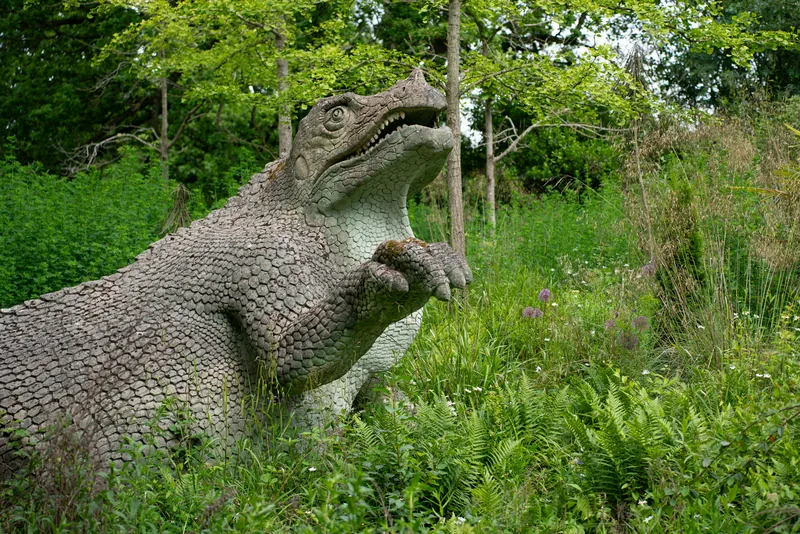
On the nose
“With the Iguanodon fossils Mantell had available to him, he determined that Iguanodon had a horn. This concept may have been based on the living iguana species Cyclura cornuta - the rhinoceros iguana - which features a small horn near its snout.” “Iguanodon’s horn was still a prevailing theory when Owen consulted on the construction of the Crystal Palace dinosaur sculptures in the 1850s.” [source] The park sculptures still wear that older idea on their faces. A later discovery had to move it.
On the thumb
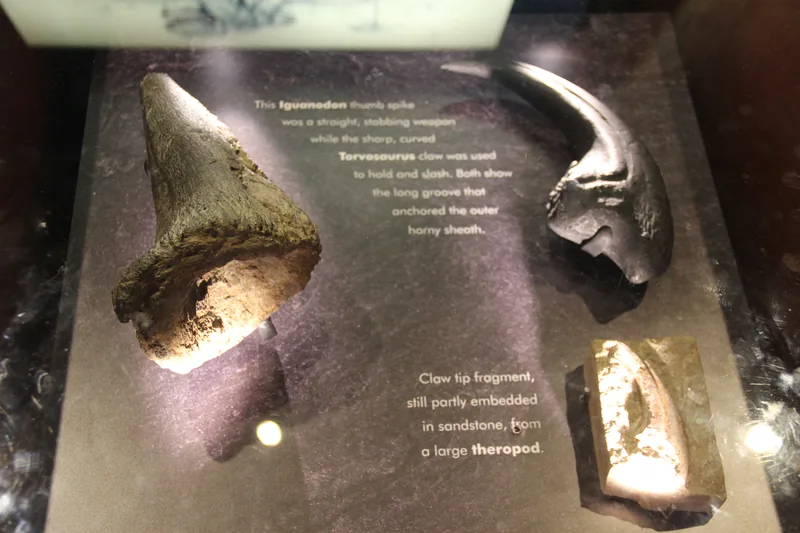
“It wasn’t until a significant Iguanodon discovery was made in the 1870s that it was proved that the spikes were thumbs rather than horns. But there is still speculation about what they were used for.” The spikes “would have been covered in keratin, whereas dinosaur fossils only show the bony core.” The museum’s directory adds a large thumb spike “probably to fend-off predators.” The Belgian institute describes “a large conical spike, coming out from the wrist itself,” covered by “a very sharp horny sheath,” and calls that thumb “a devastating weapon.” [source] [source] [source] Those official uses sit beside one another, and are not stirred into one invented purpose.
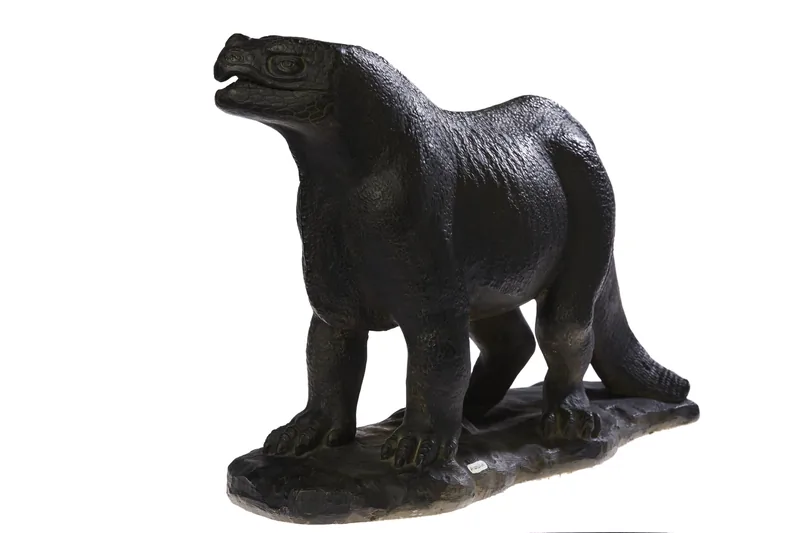
The Crystal Palace Iguanodons are the easiest way to see the older idea. They still have a horn on the nose, because that “was still a prevailing theory when Owen consulted on the construction of the Crystal Palace dinosaur sculptures in the 1850s.” [source] A one-twelfth scale model of the first sculpture, photographed for Museums Victoria, carries the same face in miniature. The Commons file says the original was “revealed in 1854.” The museum dates a dinner “prior to the completion of the Crystal Palace dinosaurs in 1853.” Those two years are left beside each other on the Crystal Palace page. They are not forced into one official opening night.
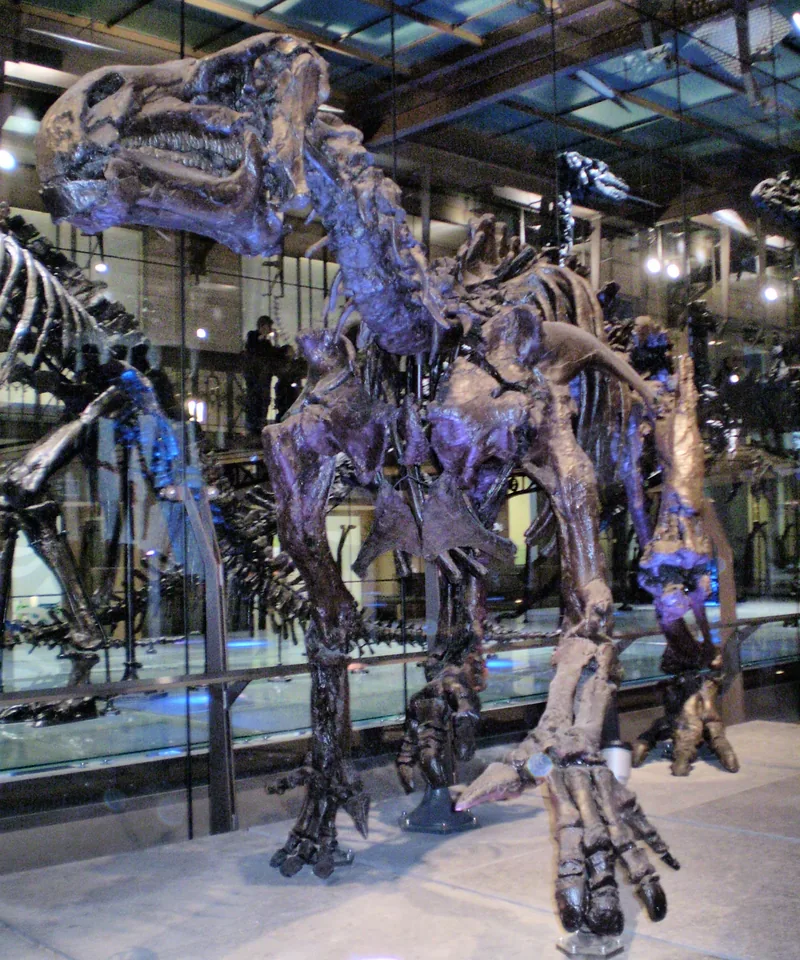
Once the spike is a thumb, the museums agree that it was sheathed, and they do not all describe its job in the same words. The discovery page says the spikes “would have been covered in keratin, whereas dinosaur fossils only show the bony core,” and that Iguanodon had “thumb spikes for food preparation or defence.” [source] The directory is shorter and more one-sided: a large thumb spike “probably to fend-off predators.” [source] The Belgian glance page is more vivid still: “a large conical spike, coming out from the wrist itself,” covered by “a very sharp horny sheath,” “a devastating weapon, especially during combat with predators.” The masterpiece page calls it “an enlarged spur, covered by a horny sheath, which it could use as a defensive weapon.” [source] [source] The search article, writing about Iguanodontia more broadly, says the thumb spikes “are thought to have been used as the dinosaur’s primary defence against predators.” [source]
Those are official uses, not a menu from which this desk picks a favourite. Food preparation or defence is not rewritten as only defence. “Probably” is not deleted. “Devastating weapon” is not treated as a quieter synonym. The hand around the spike is more than a weapon anyway. “Iguanodon’s hands were multifunctional.” Three middle fingers were “fused into a ‘hoof’ for walking on,” and a fifth finger was “possibly used for grasping.” [source] The Belgian institute reaches for a familiar tool: the hand is “like a Swiss army knife,” with “three completely different functions spread around the five digits.” [source] That wider story belongs on the hand page, with the spike still in view.
A typographic sheet keeps the two positions, and the unblended uses, without photographs: On the nose, or on the thumb? (A4) · Letter.
Enjoyed this desk on a horn that became a thumb, and a mine full of Iguanodons?
No pop-ups. No intrusive advertising. Just interesting stuff. A little support helps the next dinosaurs.im site get built.