Kent, 1834
The Maidstone slab, also known as the Mantell-piece
A limestone quarry, a blast, and a quarry owner who put the pieces back together. This desk keeps the museum’s name for the slab, and does not relabel it on its own authority.
“For several years Gideon searched for more evidence of Iguanodon. Although finds were plentiful, they were usually isolated bones and teeth.” Then, in 1834, “some workmen accidentally blew up a slab of rock in a limestone quarry near Maidstone in Kent.” [source] The official story from there is almost a detective story, and it belongs to the quarry owner as much as to the surgeon. “The Maidstone Slab, also known as the Mantell-piece, was discovered after being blown apart by explosives in a limestone quarry. The quarry owner, William Harding Bensted, noticed a ‘remarkable substance’ resembling petrified wood in a large fragment of rock. He then searched for and reassembled the many pieces blown apart by gunpowder.” Gideon “travelled to Maidstone to investigate and attributed the bones to Iguanodon.” [source]
The nickname is the museum’s: Mantell-piece. It is a pun with a straight face, and this desk leaves it as a also-known-as, not as a joke it invented. The bones in the slab gave Mantell more of the animal than isolated teeth had done, and they fed the reconstruction that still had a horn on the nose. The later move of that spike to the thumb is a 1870s story, told on the spike desk. The slab itself stays in 1834.
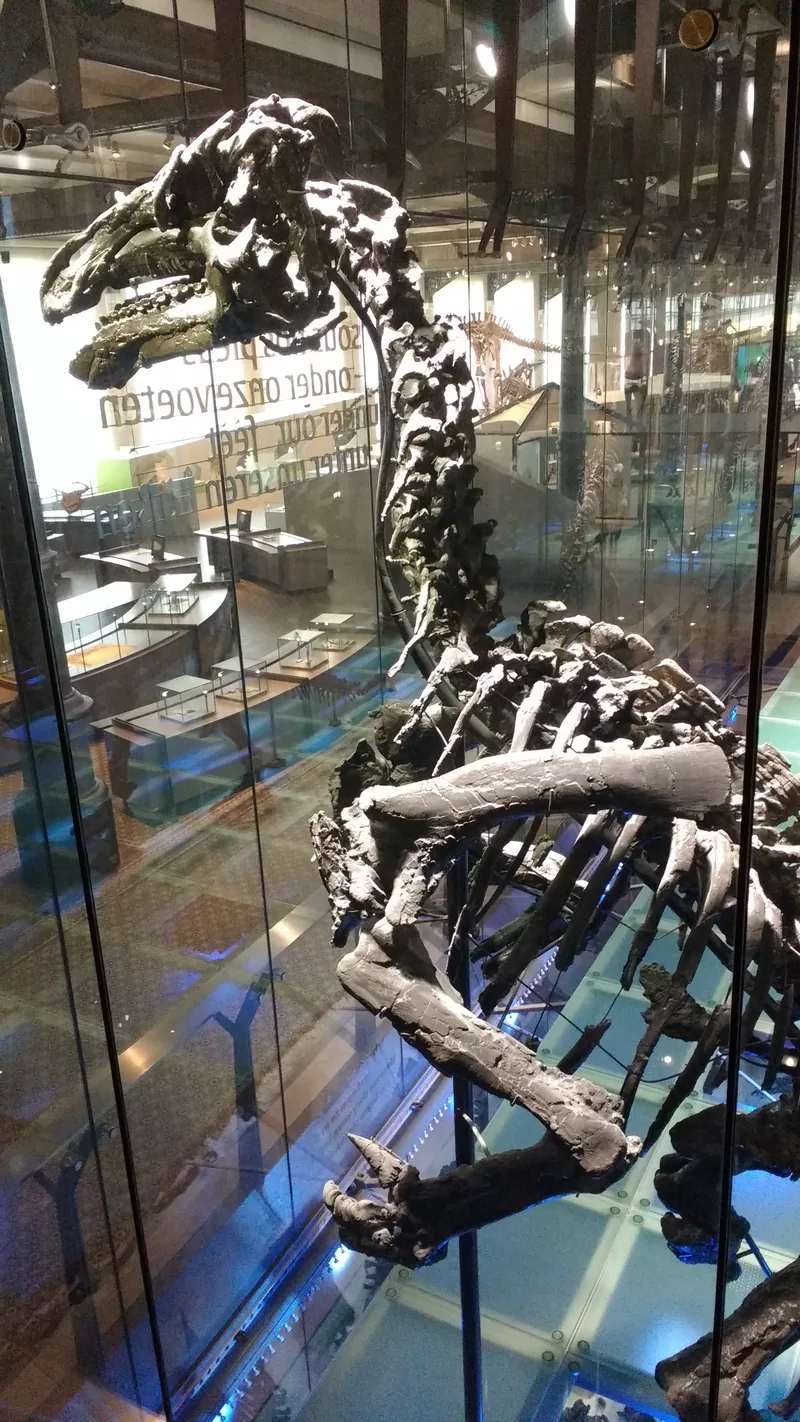
Later palaeontology has been less willing to keep every English Iguanodon under one name. The museum’s search article is the official wording used here: Mantellisaurus atherfieldensis “has spent 80 years known as Iguanodon atherfieldensis.” It is “of a lighter build than its previously associated Iguanodon relations, such as Iguanodon bernissartensis.” Both still “are members of the same group of dinosaurs called Iguanodontia and possessed large thumb spikes.” [source] In Brussels, the glance page even measures a mounted Mantellisaurus atherfieldensis in the same glass-case series as the Bernissart Iguanodons: “391cm long and 362cm high,” against Iguanodon mounts of “629 to 730cm long.” [source] Those are mount measurements, not a reason to relabel a Kent slab from 1834.
This site is not a taxonomic revision. It does not take the Maidstone slab, or the Mantell-piece, and quietly retitle it as Mantellisaurus on its own authority. The museum’s 1834 attribution is left as the museum wrote it. The later splitting of English material is left as the search article wrote it. If a reader wants the modern name of a particular specimen, the official pages are linked from sources. The job of this page is to keep Bensted’s reassembled slab in view, and to resist the temptation to tidy the nineteenth century with a twenty-first-century pencil.
Enjoyed this desk on a horn that became a thumb, and a mine full of Iguanodons?
No pop-ups. No intrusive advertising. Just interesting stuff. A little support helps the next dinosaurs.im site get built.