iguanodon.dinosaurs.im
A tooth by the roadside, a horn that moved, and a mine full of Iguanodons
The story starts with teeth in Sussex, takes a wrong turn onto a nose, and then goes 322 metres underground in Belgium. Official wording is kept as the museums wrote it, including the places where they do not say the same thing.
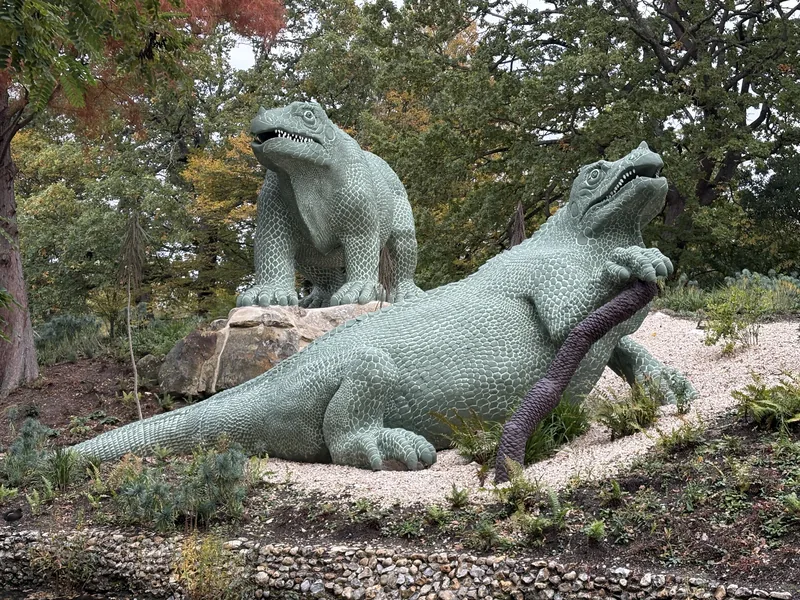
If you walk through Crystal Palace Park today, the Iguanodons still wear a horn on the nose. That is not a modern reconstruction of the living animal. It is a mid-nineteenth-century idea, left standing in a public park, and photographed here after a 2026 restoration. The Natural History Museum is gentle about how that idea began. “With the Iguanodon fossils Mantell had available to him, he determined that Iguanodon had a horn.” The concept “may have been based on the living iguana species Cyclura cornuta - the rhinoceros iguana.” And “Iguanodon’s horn was still a prevailing theory when Owen consulted on the construction of the Crystal Palace dinosaur sculptures in the 1850s.” [source]
The spike did not stay there. “It wasn’t until a significant Iguanodon discovery was made in the 1870s that it was proved that the spikes were thumbs rather than horns.” The museum still allows a little mystery after the proof: “there is still speculation about what they were used for.” [source] That official maybe lives on the spike desk, beside a directory line that the thumb spike was “probably to fend-off predators,” and a Belgian line that the same bone would be “a devastating weapon.” [source] [source] The sentences are neighbours, not a blend.
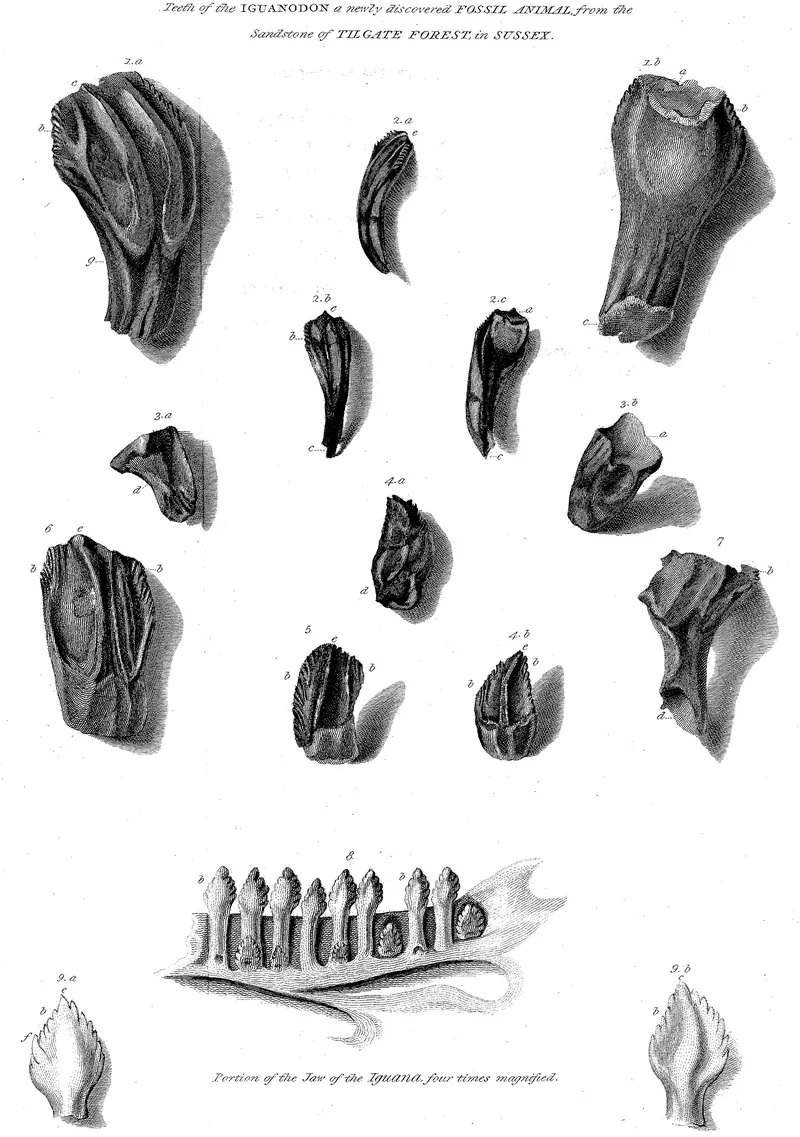
The teeth came first. A collection found in Sussex in 1822 is, the museum says, “the first evidence of a gigantic herbivorous reptile named Iguanodon.” “Most accounts hold that Mary was accompanying her husband on a trip to visit a patient in Sussex, when she noticed something glinting by the side of the road.” [source] The hedge is part of the official sentence, and this desk leaves it there. The later search article dates the formal naming: in 1825 Gideon Mantell “described several prehistoric teeth from the Wealden district of East Sussex” and, because they “looked like those of an iguana but considerably larger,” “named his newfound discovery Iguanodon.” [source] The early scaling was dramatic. The teeth “could have been up to 18 metres or longer” if you simply enlarged an iguana. “We now know this dinosaur reached a length of about 10 metres.” [source]
Even that modern length is written more than one official way. The museum’s directory gives 10.0 m and 4000 kg. The Belgian institute’s masterpiece page, writing about Iguanodon bernissartensis, gives adults “between 9 and 11 metres long,” “weighing around 8 tonnes.” [source] [source] This desk does not average them, and it does not quietly replace one date with another. The directory’s time range is 140–110 million years ago. The masterpiece page’s range, for that species, is 126–122 million years ago. Both sit on the teeth page and in the field notes.
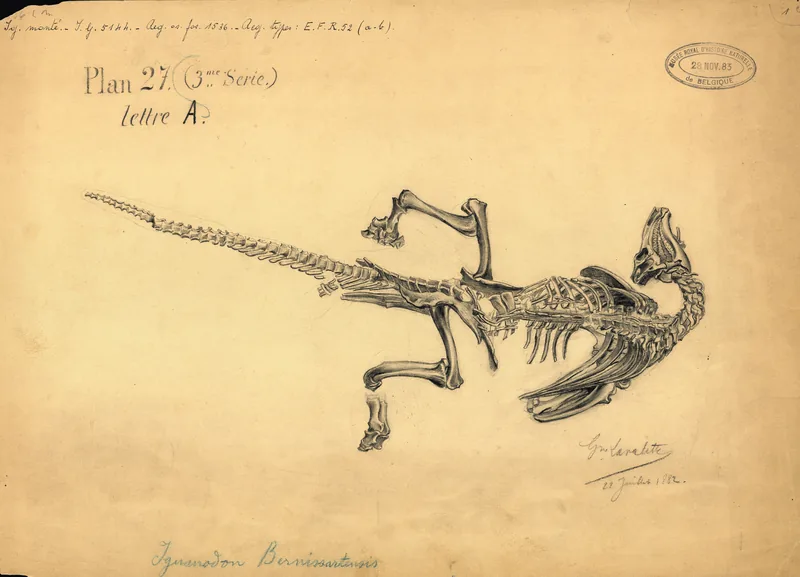
The animal that made the horn a thumb arrived from a coal mine. “By this point no complete Iguanodon skeleton had been found - until a chance discovery in a Belgian coal mine in March 1878.” Miners at “322 metres below the surface near the town of Bernissart” found bones “encrusted with pyrite (also known as fool’s gold).” [source] The Belgian glance page starts the story “at the end of March 1878 at the Bernissart coal mine in Sainte-Barbe,” and dates the telegram to the museum to 12 April 1878. The masterpiece page says “the first Iguanodon bones were discovered in April 1878.” [source] [source] March and April are both official, and they are not merged here. The skeletons — “thirty relatively complete” on one page, “around thirty” on another — are the heart of the Bernissart story, with mounts assembled in 1882 as bipeds, and a later official view that the dinosaur “predominantly walked on all fours.”
Along the way there is a quarry in Kent. In 1834 workmen “accidentally blew up a slab of rock in a limestone quarry near Maidstone.” The quarry owner, William Harding Bensted, noticed a “remarkable substance” and “reassembled the many pieces blown apart by gunpowder.” The Maidstone slab is “also known as the Mantell-piece.” [source] Later work split some English material into other names, including Mantellisaurus atherfieldensis, which “has spent 80 years known as Iguanodon atherfieldensis.” [source] This site does not relabel the Maidstone slab on its own authority. That caution lives on the Maidstone page.
Sister desks in the same family stay with neighbouring animals: Tyrannosaurus rex, Triceratops, Stegosaurus, Velociraptor, and Diplodocus. Iguanodon, the museum’s search article says, “was one of the first three dinosaurs to be discovered.” [source] Sir Richard Owen used it, “along with Megalosaurus and Hylaeosaurus,” “to coin the word ‘dinosaur’ in 1842.” [source]
Enjoyed this desk on a horn that became a thumb, and a mine full of Iguanodons?
No pop-ups. No intrusive advertising. Just interesting stuff. A little support helps the next dinosaurs.im site get built.