A Swiss army knife, officially
A multifunctional hand
Five digits, three jobs, and a spike whose official uses are not quite the same sentence on every page.
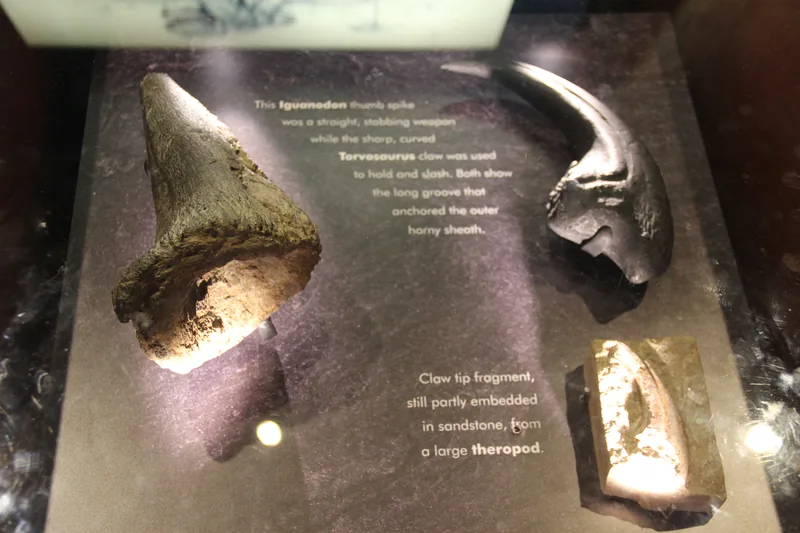
Gary Todd’s 2017 photograph at the Natural History Museum, London, shows what fossils can show: the bony core of the thumb spikes. “The spikes would have been covered in keratin, whereas dinosaur fossils only show the bony core.” [source] The Belgian institute says the same thing with a different word: the conical spike “would be covered by a very sharp horny sheath.” [source] Keratin, and a horny sheath, are official neighbours. This desk does not treat one as a translation of the other, even when they are clearly describing a covering.
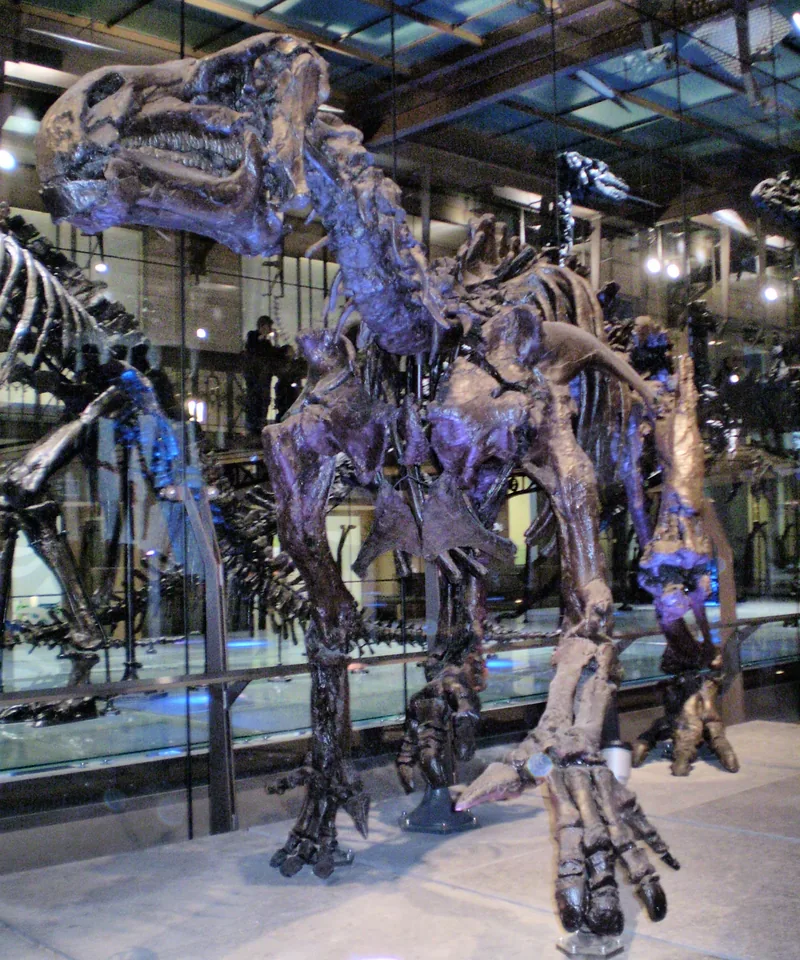
The rest of the hand is the reason the spike is not the whole story. “Iguanodon’s hands were multifunctional. It had thumb spikes for food preparation or defence, three middle fingers fused into a ‘hoof’ for walking on and a fifth finger that was possibly used for grasping.” [source] The Belgian glance page enjoys the comparison: “Multifunctional like a Swiss army knife,” with “three completely different functions spread around the five digits of the iguanodon hand.” One of those functions, on that page, is that a digit “could be used for grasping (possibly vegetation).” Then “the extraordinary thumb,” “coming out from the wrist itself,” “a devastating weapon, especially during combat with predators that would try to prey on the iguanodon.” [source]
Other official pages choose a narrower job for that thumb. The directory: “probably to fend-off predators.” The masterpiece page: “an enlarged spur, covered by a horny sheath, which it could use as a defensive weapon.” The search article, on Iguanodontia: thumb spikes “thought to have been used as the dinosaur’s primary defence against predators.” [source] [source] [source] Food preparation or defence is the broadest official pair. Primary defence, probably fend-off, defensive weapon, and devastating weapon are all official too. The spike desk is where those sentences sit together, without a winner.
The hoof matters for walking. If three middle fingers were fused for walking on, the hand is part of the locomotion story told on the Bernissart page: assembled as a biped in 1882, later described as predominantly walking on all fours, with a masterpiece page that still calls the posture “debated.” A hand that can walk, grasp, and spike is a good reason not to reduce Iguanodon to a single gesture.
Enjoyed this desk on a horn that became a thumb, and a mine full of Iguanodons?
No pop-ups. No intrusive advertising. Just interesting stuff. A little support helps the next dinosaurs.im site get built.