Belgium, 1878
The Bernissart Iguanodons, 322 metres underground
A coal mine, a pocket of clay, and the first complete, articulated skeletons of large dinosaurs. Official pages do not all date the first bones to the same month, and they do not all count the skeletons with the same phrase.
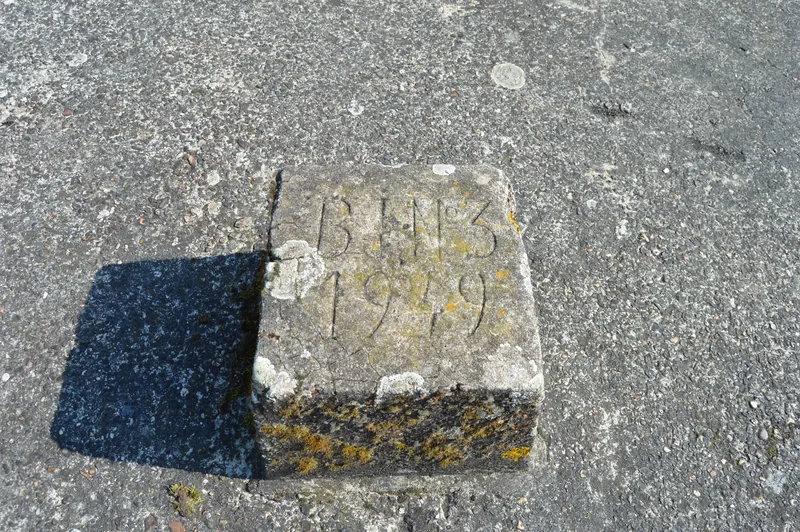
The former Sainte-Barbe pit 3 at Bernissart was photographed by Bel Adone on 27 March 2013. The official discovery happened long before that quiet surface view. The Natural History Museum’s wording is a chance find: “no complete Iguanodon skeleton had been found - until a chance discovery in a Belgian coal mine in March 1878. Miners digging at 322 metres below the surface near the town of Bernissart began to dig through a pocket of clay when they discovered numerous bones encrusted with pyrite (also known as fool’s gold).” [source]
The Belgian institute tells the same mine with more dates, and they are not identical. “The story starts at the end of March 1878 at the Bernissart coal mine in Sainte-Barbe. Miners were digging at 322m when they came across a pocket of clay. Instead of going around it, they decided to go through.” “On 12 April 1878, the Belgian Royal Museum of Natural History (as it was then known) was informed of the discovery by telegram.” [source] The masterpiece page, describing the holotype specimen, says “the first Iguanodon bones were discovered in April 1878 in the Bernissart colliery (Mons Basin, Belgium).” [source] March, the end of March, and April are all official. This desk does not pick a winner, and it does not write “March or April” as if that were a quotation.
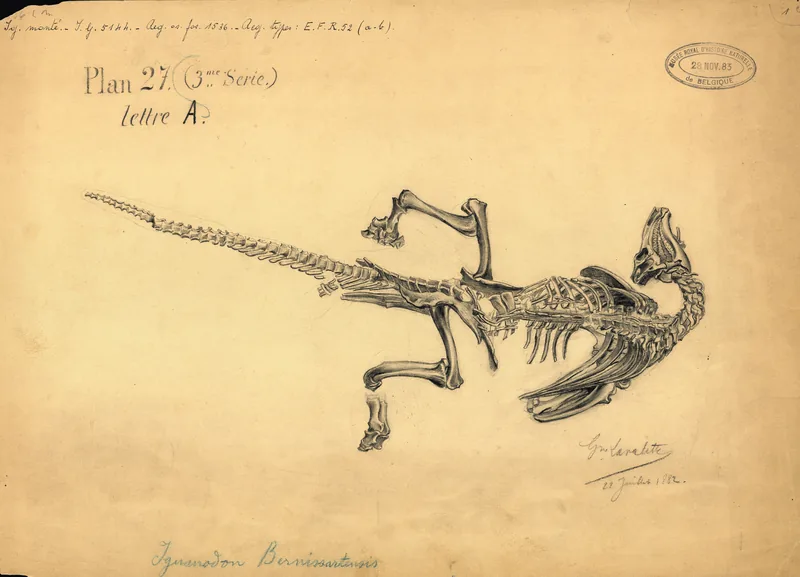
Gustave Lavalette drew Iguanodon bernissartensis “lettre A” on 22 July 1882, as the animal was discovered — a reminder that the bones arrived as a buried posture, not as a standing mount. The glance page says that “since the bones were still in their original position, it was possible to present the skeletons in ‘lifelike’ poses.” [source] The count is written two official ways. “Thirty relatively complete iguanodon skeletons were discovered 322m underground.” The masterpiece page says a dig “lasting more than two years” “unearthed around thirty remarkably well-preserved Iguanodon skeletons,” “the very first discovery of complete, articulated skeletons of large dinosaurs.” [source] Thirty relatively complete, and around thirty, stay in their own sentences.
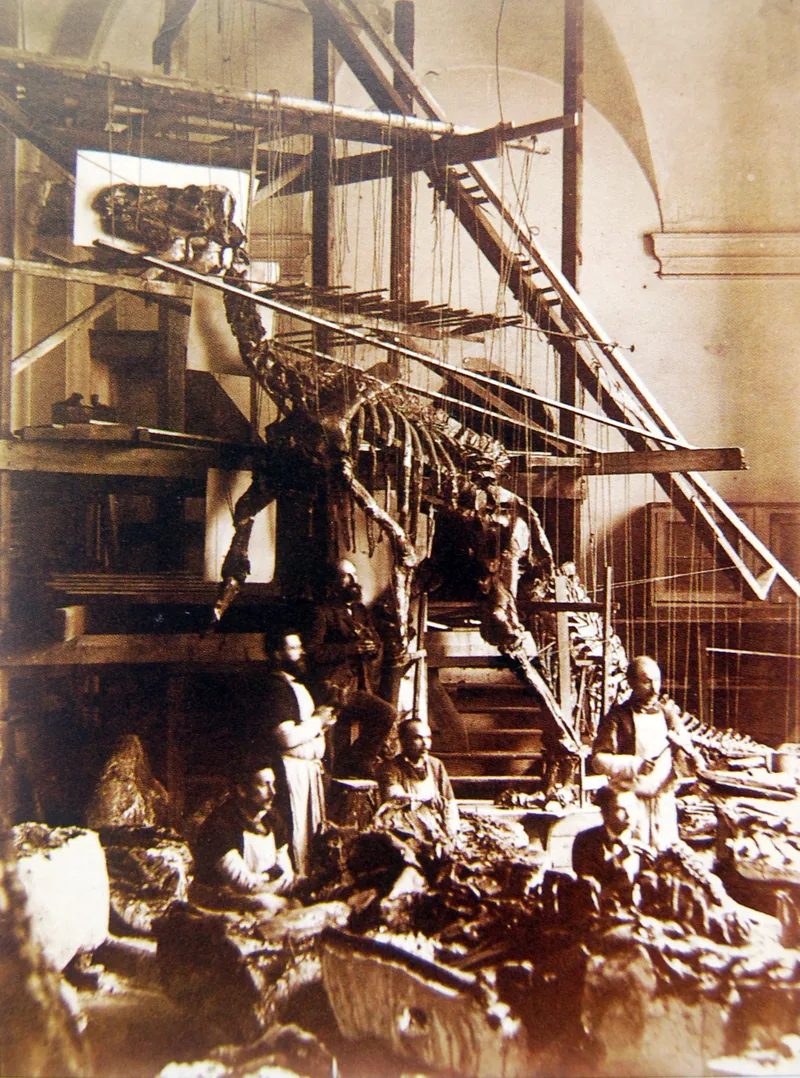
Getting them to Brussels was a labour of plaster and iron. “Covered in plaster for protection and broken into 600 blocks, the fossils were transported to Brussels to be reassembled and fitted with iron frames.” “For the first time, scientists were able to see what a complete dinosaur might have looked like.” [source] Aimé Rutot photographed workmen mounting the first Iguanodon bernissartensis skeleton in the St George Chapel in 1882. The glance page names the supervision: “In 1882 the Iguanodons were assembled with a biped posture. Louis Dollo, who supervised this very first assembly, was convinced that the Iguanodon bernissartensis was a biped.” He had reasons: the front and hind legs, the spinal column, the hips, a comparison with ratites, “and lastly, a fossil track discovered in England.” The first assembled specimen “was put on display in the inner courtyard of the former Palace.” [source]
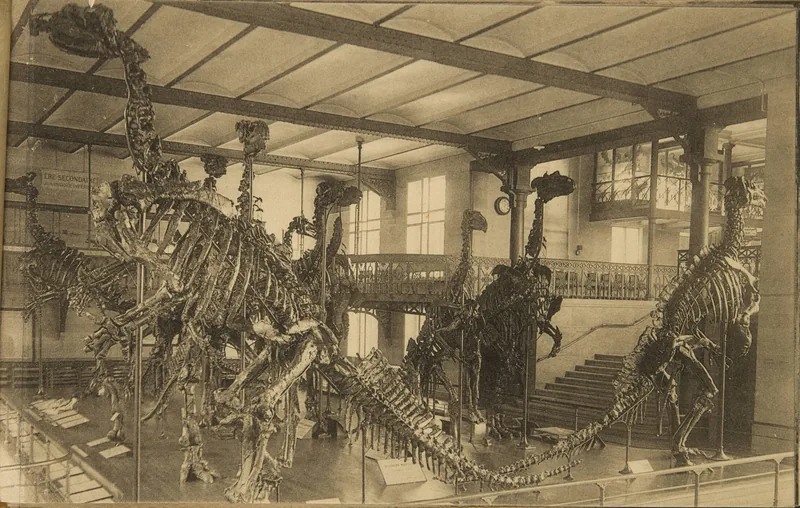
A historic photograph of the mounted group “in the attitude of life,” in the vertebrate hall, shows that biped idea as a public spectacle. The Commons file does not name the photographer or a publication date, so this desk does not invent either. What the museums now say about walking is different, and not quite the same on every page. The Natural History Museum is direct: “The giant dinosaur puzzles were assembled based on knowledge of the time, that Iguanodon was bipedal. We now know the dinosaur predominantly walked on all fours.” The mounts “are now too fragile to be repositioned into life-like postures,” and “remain a vestige of nineteenth-century thinking.” [source] The glance page agrees that the “kangaroo” posture “was no longer relevant,” and that the original skeletons “remain as they are because they are too fragile to be changed,” with a caption that simply says “Iguanodon walked on all fours.” [source] The masterpiece page is more open: “the posture and mode of locomotion of this dinosaur are still debated.” Some palaeontologists, it says, “think that it ran in a bipedal position… but could rest on its front legs when walking.” [source] Predominantly on all fours, walked on all fours, and still debated: three official later views, not one blended gait.
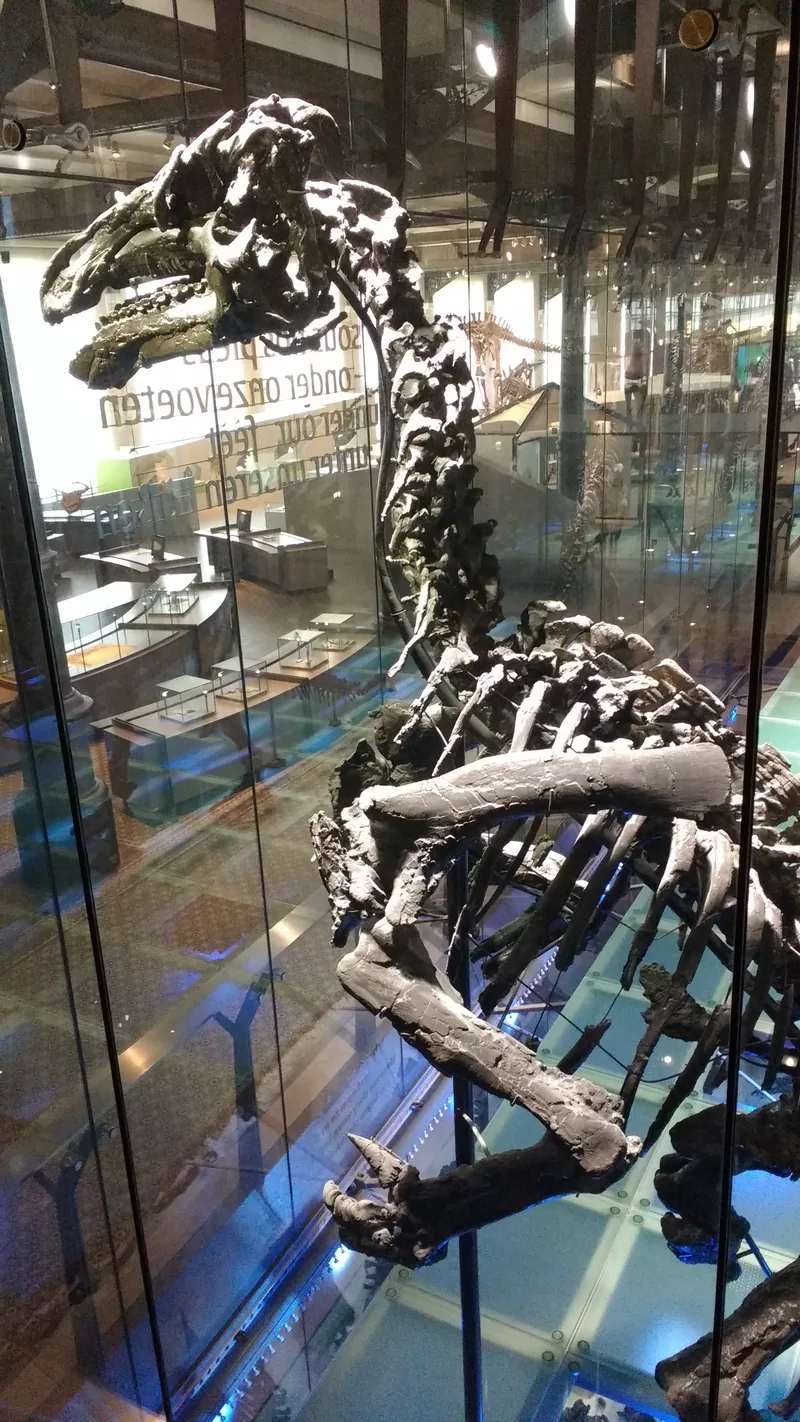
The animal in the modern gallery is still, officially, a large herbivore with more than one size. The masterpiece page gives adults “between 9 and 11 metres long, weighing around 8 tonnes,” living “126-122 million years ago” in “England, Belgium, Germany and Spain.” [source] The museum directory, for Iguanodon as it lists the genus and type, gives 10.0 m, 4000 kg, and 140–110 million years ago, found in Belgium, England, and the United Kingdom. [source] In the glass case, the mounted Iguanodons “range from 629 to 730cm long and 390 to 506cm high.” [source] Those centimetres measure the mounts. They are not treated here as a third living length. IRSNB R51, the masterpiece page says, “is the holotype of Iguanodon bernissartensis.” [source] The type species credit on the directory is “Boulenger and van Beneden (1881),” which sits beside Mantell’s 1825 genus name without cancelling it. A typographic sheet keeps the mine, the counts, and the dates: The Bernissart Iguanodons (A4) · Letter.
The mine itself is closed to further searching. “The Bernissart mineshafts have long since been filled and sealed, making it impossible to search for other Iguanodons.” [source] What remains is the gallery, the drawings, and the official wording that still disagrees, politely, about a month and a gait.
Enjoyed this desk on a horn that became a thumb, and a mine full of Iguanodons?
No pop-ups. No intrusive advertising. Just interesting stuff. A little support helps the next dinosaurs.im site get built.