Sydenham
Crystal Palace, a dinner inside a dinosaur, and a horn that stayed put
The park sculptures still show the idea that was prevailing in the 1850s. The museum dates a dinner before completion in 1853. A later file caption says the original was revealed in 1854. Both wordings are here.
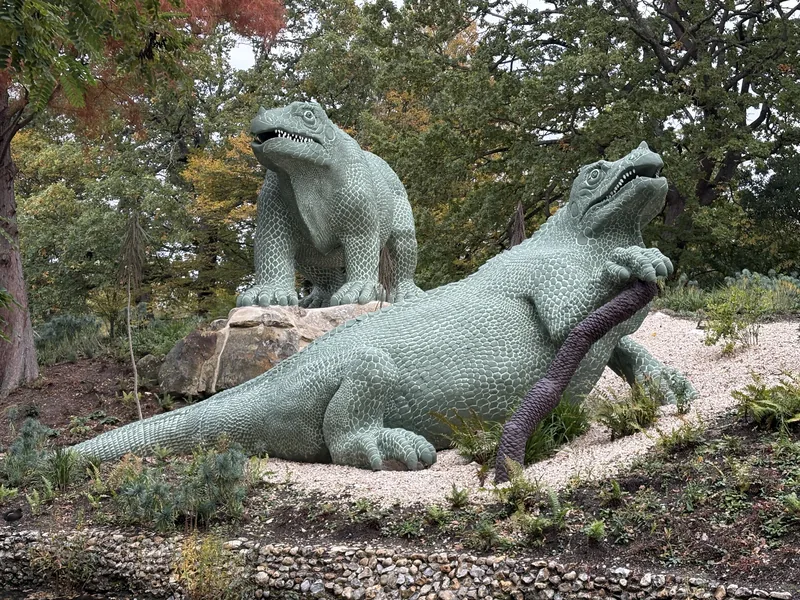
The photograph on this page was taken by A Cynical Idealist on 4 November 2026, after the sculptures “being restored in 2026.” The photographer also calls them “anachronistic sculptures of the ornithopod Iguanodon,” which is a fair modern word for a mid-nineteenth-century face. The official reason they look that way is older than the restoration. “Iguanodon’s horn was still a prevailing theory when Owen consulted on the construction of the Crystal Palace dinosaur sculptures in the 1850s.” [source] Owen had already, in 1842, “used Iguanodon (along with Megalosaurus and Hylaeosaurus) to coin the word ‘dinosaur’.” The sculptures were born inside that new word, and inside an older idea about a horn.
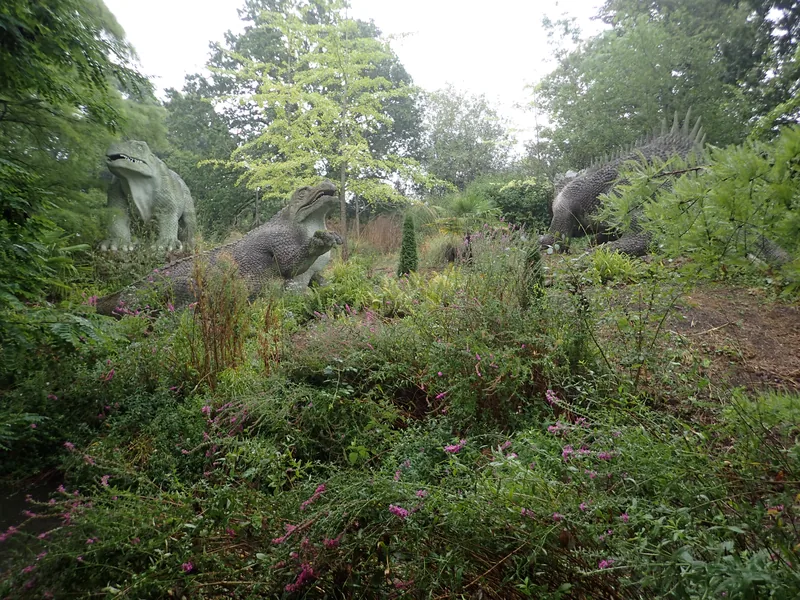
A year earlier, on 6 September 2024, Marathon photographed the same pair in the park. Tom Page’s closer view of 8 June 2024, on the spike desk, makes the nose unmistakable. The sculptures have been standing in the park since the 1850s, which is why the shop card can start with the year you were. This rebuild does not repeat Historic England construction dates, because those official pages could not be re-opened on 18 November 2026. The museum’s own dating is used instead: construction “in the 1850s,” and a dinner “prior to the completion of the Crystal Palace dinosaurs in 1853.” [source]
That dinner is one of the tender official facts on this desk. “Prior to the completion of the Crystal Palace dinosaurs in 1853, several notable scientists were invited to a dinner inside the Iguanodon sculpture.” [source] The museum does not, on the page re-opened for this rebuild, give a guest list or a menu. This desk does not invent one. What it keeps is the picture the sentence already holds: the animal was large enough, as a sculpture, to eat inside, and the people who advised on it were invited in before the work was finished.
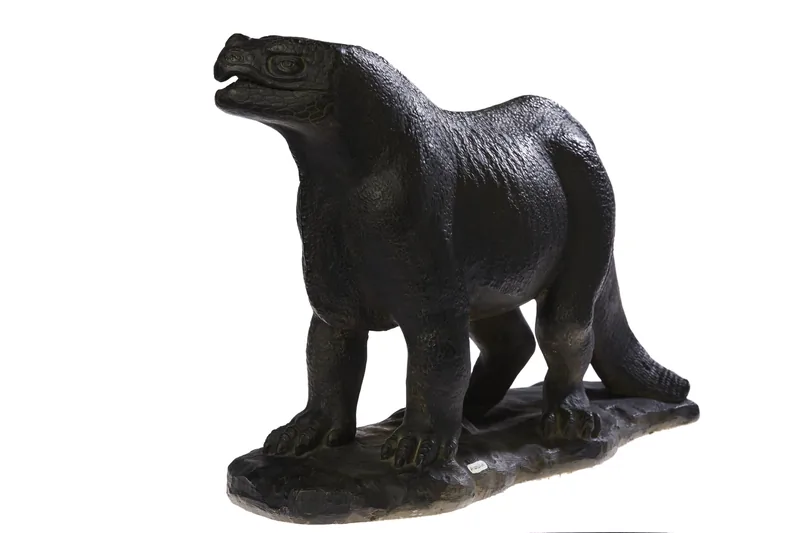
A one-twelfth scale model of the first sculpture, photographed by Rodney Start for Museums Victoria, carries a different year on its Commons file. The file labels the work 1854, and its caption says “the original was revealed in 1854 in Crystal Palace Park in London, where it still stands today.” That is the file’s wording, not the museum’s. The museum’s completion date is 1853, with the dinner set before that completion. This page refuses to flatten 1853 and 1854 into a single opening date. The model is a model. The sculptures in the park are the sculptures in the park. The years stay in the sentences that own them.
Benjamin Waterhouse Hawkins appears on the museum’s discovery page as the artist of a drawing of two Iguanodons and Hylaeosaurus. This desk does not add a biography beyond that official mention. The sculptures remain the best public reminder of a horn that later moved. After the 1870s, “it was proved that the spikes were thumbs rather than horns.” [source] The park, very reasonably, did not get up and walk the spike down the face. Visitors still meet the 1850s idea first, and then, if they want the later anatomy, they can go on to Bernissart.
Enjoyed this desk on a horn that became a thumb, and a mine full of Iguanodons?
No pop-ups. No intrusive advertising. Just interesting stuff. A little support helps the next dinosaurs.im site get built.